
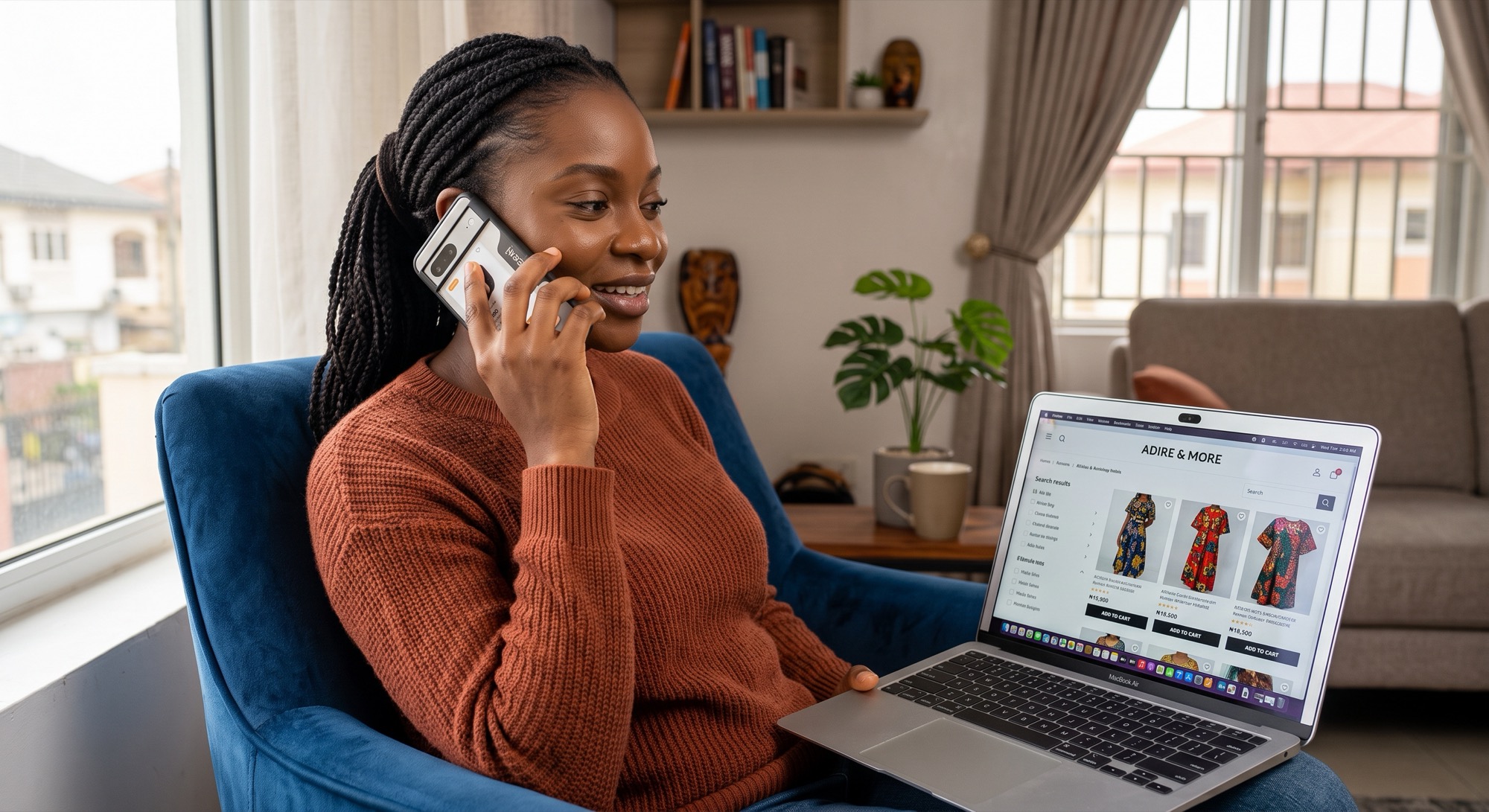
There was a time when finding a customer was the hardest part of doing business. A salesperson had to go looking for buyers — door to door, market stall to market stall, phone call to phone call — hoping to catch someone at the right moment with the right pitch. Today, that entire relationship has reversed. The buyer finds you.
This shift isn't a vague feeling about "how things have changed." It's visible in the numbers, and it has very concrete implications for how a Nigerian business — big or small — needs to show up.
Yesterday's buyer: waiting to be found
For most of the last century, commerce ran on outbound effort. Businesses invested in shopfronts, billboards, radio jingles, and sales reps whose job was to physically locate prospective buyers and market to them. Information about products lived almost entirely with the seller. If you wanted to compare prices or quality, you visited multiple shops in person, asked around, or trusted whatever the salesman in front of you said. The buyer was, in a very real sense, passive — waiting to be reached.
Today's buyer: searching, scrolling, and deciding first
That model has been turned on its head. The modern buyer starts the journey themselves — usually with a search engine or a social media scroll — long before any salesperson enters the picture.
The scale of this shift in Nigeria specifically is hard to overstate. As of late 2025, Nigeria had roughly 109 million internet users, a 45.5% internet penetration rate, and 165 million active mobile connections — a 69.2% penetration rate that grew by 16 million connections in a single year (DataReportal, Digital 2026: Nigeria). Globally, Google alone handles over 91% of search engine traffic across all devices (Statista, July 2026) — meaning that for the overwhelming majority of buyers looking for a product or service, "search" effectively means Google. If your business isn't easily found there, you are, for most practical purposes, invisible to a search-first buyer.
This isn't just a Nigerian or global anecdote — it's a well-documented behavioral pattern. A frequently cited GE Capital Retail Bank shopper study found that 81% of consumers research a purchase online before ever setting foot in a store, a finding that has held up as online research habits have only deepened since. The buyer today does the homework first, and arrives at a decision — or at least a shortlist — before a business ever gets the chance to make its pitch.
Why SEO and online presence are no longer optional
Put simply: if yesterday's business needed a good salesperson, today's business needs to be find-able. Search engine optimization (SEO), an active social media presence, and clear, accurate information about what you sell and where you're located have become as fundamental as having a working phone line once was. A business with a weak or nonexistent online presence is, to a search-first buyer, functionally the same as a shop with no signage on a street no one walks down.
No shop, no problem
One of the more liberating effects of this shift, especially for Nigerian entrepreneurs, is that a physical storefront is no longer a prerequisite for serious business. A huge share of Nigeria's growing e-commerce activity is happening through phones, social pages, and messaging apps rather than shop visits. The Nigerian e-commerce market was valued at roughly $9.35 billion in 2025, is projected to reach about $10.49 billion in 2026, and is forecast to grow to nearly $18.68 billion by 2031 — a compound annual growth rate above 12% (Mordor Intelligence). Strikingly, smartphones already account for over 82% of e-commerce transactions in Nigeria, underscoring just how mobile-first the buying journey has become.
From the comfort of home, a Nigerian entrepreneur can list products online, take orders through DMs or WhatsApp, and get goods to customers using the dispatch rider networks that have become the backbone of urban last-mile delivery in cities like Lagos — no rent, no shop fittings, no overhead of a physical retail space required. The businesses winning in this environment aren't necessarily the biggest; they're the ones that are easiest to discover and easiest to buy from.
The moment of truth: when the buyer picks up the phone
Here's where many otherwise well-run online businesses lose the sale. A buyer finds you online, likes what they see, and then does the thing that still closes most serious transactions: they call.
That phone call is a moment of truth — and how it's answered says more about your business than your website ever could. A call answered on someone's personal mobile line, with background noise, no greeting, and no structure, signals a hobby. A call answered by a proper business line — with a professional greeting, a simple IVR menu directing the caller to the right department, and a calm, prepared voice on the other end — signals a company that takes itself, and its customers, seriously. It's the difference between "is this business even real?" and "I'm in good hands."
This is precisely the gap that separates businesses that convert online interest into paid customers from those that lose buyers at the last step.
Closing the gap: how Vezeti helps you sound as serious as you are
This is exactly the problem Vezeti's communication solutions are built to solve — for businesses at any stage.
If you're a growing enterprise handling high volumes of customer calls across voice, WhatsApp, and other channels, VezetiCC gives you a full omnichannel contact center — professional IVR, call routing, recording, and supervisor tools — so every customer interaction feels organized and intentional, not chaotic.
If you're a small or home-based business that can't yet justify a full contact center but still needs to sound credible the moment a buyer calls, VezetiPBX delivers that enterprise-level phone experience on a small-business budget: a professional auto-attendant greeting, ring groups so no call goes unanswered, and call analytics — all reachable on a branded business number you can pick up from anywhere, including your living room.
The buyer has changed. They find you first, research you thoroughly, and judge you fast. Make sure that when they finally pick up the phone, what they hear matches the quality of what they already found online.
This post is part of an ongoing weekly series on telecommunications, business growth, and digital transformation from Vezeti.
💬 Questions & Comments
Loading comments…
Leave a comment