

In January 2027, the United Kingdom will formally retire the PSTN — the Public Switched Telephone Network — the copper-wire system that has carried British phone calls for more than a century. Openreach, the company that runs the UK's physical phone network, has been preparing customers for years: move to a digital phone line, or risk being left on a bare-bones emergency service once the old exchanges go dark.
It's a big, carefully managed transition for the UK. For Nigeria, though, it's almost old news. Not because we planned it that way, but because years of a uniquely Nigerian set of challenges pushed much of our landline network into irrelevance long before any regulator sat down to schedule a "switch-off." This post looks at how we got here — and what it means for Nigerian businesses still holding on to the old technology.
From copper wires to ADSL: the landline era
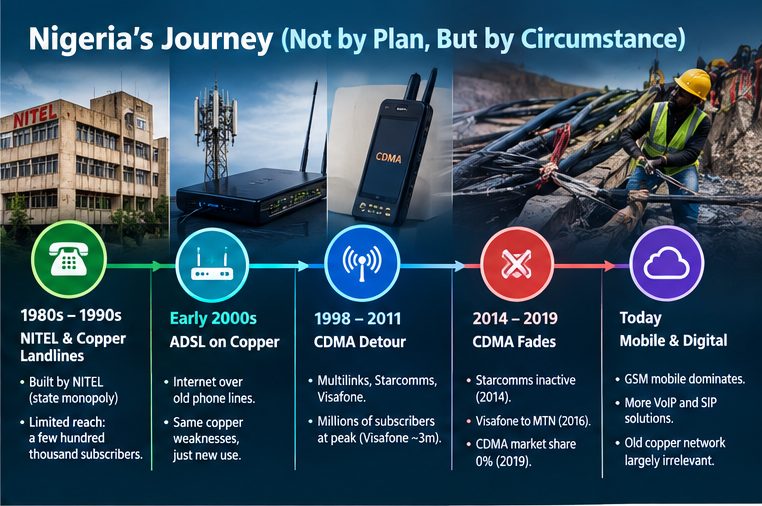
The PSTN, in its simplest form, is the original telephone network — copper wires running from a telephone exchange into individual homes and offices, carrying a call as an analogue electrical signal. In Nigeria, this network was built and operated for decades almost exclusively by NITEL (the Nigerian Telecommunications Limited), the state monopoly. By the early 1990s, NITEL's network had grown to a few hundred thousand subscribers nationwide — a modest number for a country of Nigeria's size, and one that reflected how hard it was to extend copper infrastructure across the country.
Later, that same copper network was pressed into new service through ADSL (Asymmetric Digital Subscriber Line) technology, which squeezed broadband internet signals down the same old phone wires. It was clever engineering, but it inherited every weakness of the copper network beneath it: distance-limited, maintenance-hungry, and entirely dependent on physical cable that had to survive Nigerian roads, Nigerian weather, and Nigerian realities on the ground.
The CDMA detour: Nigeria's first attempt to leapfrog copper
Before GSM mobile phones became the default, Nigeria had a genuine shot at a wireless alternative to copper landlines: CDMA (Code Division Multiple Access) fixed-wireless telephony. Multilinks became Nigeria's first private telephone company in December 1998, offering fixed and mobile service that broke NITEL's monopoly. Starcomms and Visafone followed, and at their peak these CDMA operators served millions of Nigerian homes and small offices — Visafone alone reached roughly three million subscribers around 2010–2011.
It didn't last. GSM mobile networks scaled faster and cheaper, and one by one the CDMA players fell away: Starcomms was declared inactive by the Nigerian Communications Commission (NCC) in 2014, Visafone was absorbed into MTN's GSM network in 2016, and by April 2019 the NCC confirmed CDMA's market share had fallen to zero, as the last handful of subscriptions were migrated or switched off entirely. Nigeria's fixed-wireless landline experiment was over almost as quickly as it began.
Why copper never stood a chance in Nigeria
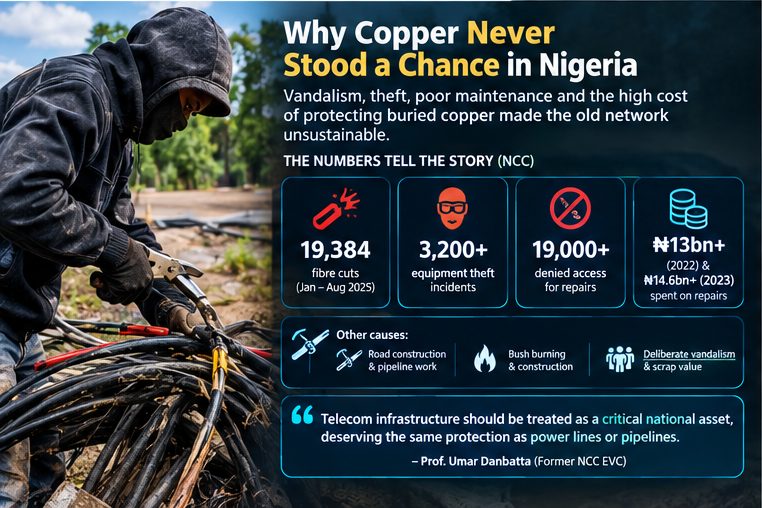
While GSM mobile was winning the market on its own merits, Nigeria's remaining copper infrastructure was fighting a losing battle against a very different enemy: physical destruction. Vandalism of telecom cables — including the old NITEL copper network — has been a persistent, well-documented problem for years, and it has only intensified as the value of scrap copper and the reach of fibre networks have both grown.
The numbers from the NCC itself are stark. According to the Commission, Nigeria's telecom operators recorded 19,384 fibre cuts between January and August 2025 alone, alongside more than 3,200 cases of equipment theft and over 19,000 incidents where operators were denied access to their own sites to carry out repairs. NCC Executive Vice Chairman Dr. Aminu Maida has described the country as losing fibre infrastructure at a rate of roughly 1,100 cable cuts every week, with the Commission's data showing operators spent over ₦13 billion on repairs in 2022 and ₦14.6 billion in 2023, on top of billions more in lost revenue each year. Lagos State alone recorded over 2,500 fibre cuts in 2024, with an estimated ₦5 billion in losses in that state.
The causes are a mix of deliberate and incidental damage: outright vandalism and cable theft (often for scrap value), destruction by road construction and gas pipeline crews who dig without checking what lies beneath, and damage from bush burning and other construction activity. Prof. Umar Danbatta, during his time as NCC Executive Vice Chairman, put it plainly: telecom infrastructure across the country should be treated as a critical national asset, deserving the same protection as power lines or pipelines — a call the Commission has repeated at forums across the country as it urges host communities, contractors, and local authorities to stop treating cable routes as fair game.
Against that backdrop, maintaining a fragile, buried copper network that carries old-style analogue signals was never going to be sustainable at national scale. Every kilometre of exposed copper was a kilometre waiting to be dug up, cut, or stolen.
So, is Nigeria really "ahead" of the UK?
Not in the sense of a planned, orderly national programme — the UK's PSTN switch-off is a deliberate, scheduled modernisation with a firm 2027 deadline and a managed transition for every customer, including vulnerable households and critical services like alarms and telecare devices. Nigeria never ran a programme like that.
But in a very real, practical sense, much of Nigeria's PSTN reality has already been switched off — not by regulatory decree, but by circumstance. Years of vandalism, theft, poor maintenance economics, and the sheer cost of protecting buried copper across such a large country meant that traditional fixed-line telephony never scaled the way it did in the UK, and what existed decayed faster than it could be repaired. Nigerian homes and businesses leapfrogged straight past the copper-and-ADSL era into mobile and, increasingly, SIP-based digital telephony — arriving at a post-PSTN world years before a developed market like the UK gets there by design.
Where Vezeti comes in
This is exactly the transition Vezeti exists to support — meeting Nigerian businesses wherever they currently stand on that journey.
For businesses that still have a working analogue PBX system — the old-style office phone switchboard, often inherited along with the building — the good news is that moving to digital telephony doesn't have to mean ripping anything out. Vezeti can connect a digital telephone service directly to your existing analogue PBX, keeping your current handsets, your existing internal wiring, and the PBX unit itself exactly as they are. The switch happens behind the scenes, converting your calls to modern digital technology without disrupting the office your staff already know how to use. It's a practical, low-disruption first step for businesses not ready for a bigger overhaul.
For businesses ready to go further, Vezeti can take that same organisation all the way to a fully digital, SIP-based Unified Communications setup — cloud PBX, mobile extensions, contact centre capability, and all the flexibility that comes with modern voice infrastructure. The point isn't to force every customer onto the same path at the same pace; it's to make sure that wherever a business is starting from — legacy analogue, fixed-wireless relic, or nothing at all — there's a realistic, affordable route forward from there.

Nigeria didn't get to a post-PSTN world by design. But now that we're here, there's no reason to build the next chapter the hard way.
This post is part of an ongoing weekly series on telecom and business topics from Vezeti.
💬 Questions & Comments
Loading comments…
Leave a comment