
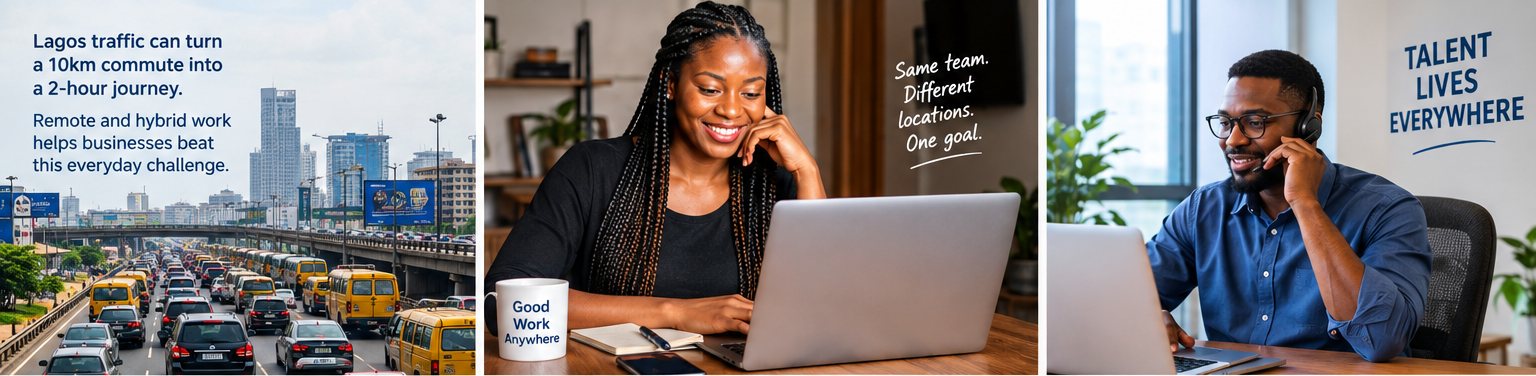
A few years ago, "working from home" in Nigeria mostly meant a sales rep who couldn't make it into traffic that day. Today, it's a deliberate way many businesses are choosing to operate — and for good reason. Lagos traffic alone can turn a desk ten kilometres away into a two-hour commute each direction. Office rent in Lagos, Abuja, or Port Harcourt eats into margins that are already thin. And the best candidate for that role you're hiring might live in Enugu, or Kaduna, or simply prefer not to spend four hours a day in a bus.
Remote and hybrid work isn't a foreign trend Nigerian businesses are copying — it's a practical response to very local problems. But there's a question that trips up a lot of business owners before they even try it: if my staff aren't all sitting in one office, how do I make sure my business still sounds and runs like one?
Why more Nigerian businesses are trying this
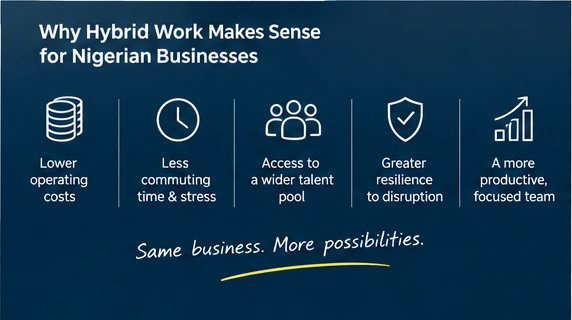
The pressures are familiar to almost anyone running a small or growing business here. Office space costs money every month whether or not anyone needs to be in it today. Commuting costs time and fuel, and a team that's exhausted from the road isn't a team doing its best work. And when you're hiring, restricting yourself to only the talent that can physically show up at one address in one city shrinks your options considerably — especially for skilled roles that are hard to fill locally.
There's also a resilience angle. A business that depends entirely on everyone being in one physical building is more fragile than it looks. A flooded road, a security situation, a building issue — any one of these can shut down a fully office-bound operation for a day or more. A business that already knows how to function with people working from different locations has a head start when the unexpected happens.
None of this means the office disappears. Most businesses that go this route end up hybrid — some days in, some days out, or some roles in-office and others remote. The goal isn't to empty the building; it's to stop being fragile and location-locked.
The risk nobody talks about: whose number is that, really?
Here's where a lot of businesses quietly get it wrong. When staff start working from home, the easiest thing to do is let them use their personal phones to call customers. It feels harmless at first. But think about what that actually means: every customer relationship your business builds is now sitting on an individual employee's personal GSM line.
If that staff member resigns, that customer's saved contact is gone — they don't know to call the office, they just have "Chidi" in their phone. If the staff member is unreachable for a day, so is your business, as far as that customer knows. And you have no visibility into how those calls go, how long customers wait, or whether anyone called back at all.
This is the single most common way "remote work" quietly turns into "scattered work." The fix isn't complicated, but it does require a small shift in how your phone system works.
One business number, wherever your people are
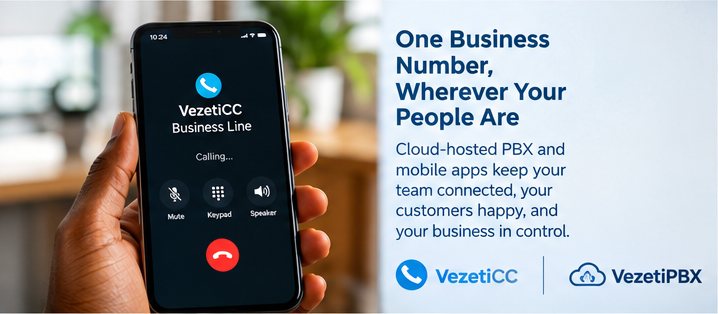
The practical solution is to decouple your business's phone number from any one physical location or any one person's SIM card. A cloud-hosted PBX does exactly this: your main business line lives in the cloud rather than on a box sitting in a specific office, and staff reach it through a mobile app, a desk app, or a softphone — from home, from a branch office, or from the road.
A customer calling your main number doesn't need to know or care whether the person answering is in the Lagos office or working from Owerri that week. Calls can route by department, by time of day, or to whichever staff member is actually available — rather than depending on a customer having memorized the right personal number. If someone leaves the company, the business keeps its number, its call history, and its customer relationships. Nothing walks out the door with them.
This is the role products like VezetiPhone play — putting your business line on a mobile device without tying it to a desk or a specific SIM — and VezetiPBX, which gives the whole business one switchboard regardless of where staff are physically sitting. The specific tool matters less than the principle: your business's voice presence should belong to the business, not to whoever happens to be holding the phone that day.
Beyond the phone: making hybrid actually work
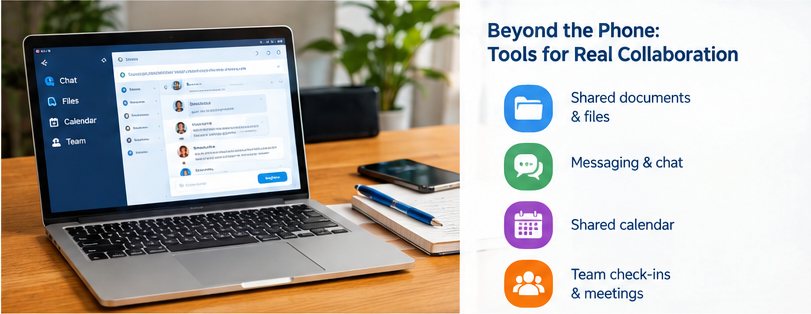
Phones are the piece that's easy to overlook, but they're not the only piece. A hybrid team also needs a shared place for documents and files so nobody is emailing spreadsheets back and forth; a reliable messaging or chat tool for quick questions that don't need a phone call; a shared calendar so meetings get scheduled without ten back-and-forth messages; and some agreed rhythm — a daily check-in, a weekly team call — so remote doesn't quietly drift into "out of touch."
None of this needs to be expensive or complicated. Many of these tools have free or low-cost tiers that are more than enough for a small team. The mistake to avoid is assuming that just because everyone has WhatsApp, that's a complete collaboration strategy. WhatsApp is excellent for quick, informal communication; it's not a system of record, and it's definitely not a substitute for a proper business phone line.
Building in resilience from the start
The businesses that handle disruption well — a bad storm, a security scare, a sudden office closure — are usually the ones that were already set up to let people work from wherever they needed to be. That's really the core benefit of getting hybrid work right: it's not only about saving on rent or widening your hiring pool, though those matter. It's about building a business that doesn't grind to a halt just because a building becomes inaccessible for a day.
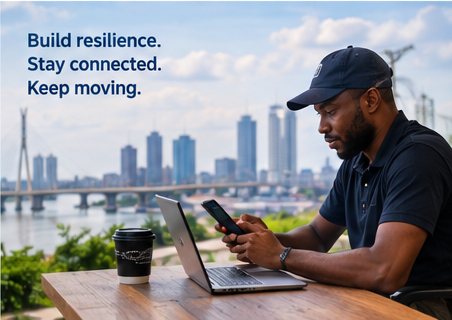
If you're just starting to think about this, you don't have to solve everything at once. Start with the phone system, since that's the piece most directly tied to how customers experience your business. Get your team reachable under one business number, wherever they're sitting, and the rest — the shared documents, the chat tools, the meeting rhythm — tends to follow naturally once that foundation is in place.
Whether your business today is running on a single analogue line in one office, or you're ready to move your whole team onto a cloud-based setup, the path doesn't have to be all-or-nothing. It's entirely possible to modernize one piece at a time, at a pace that fits your budget and your business — starting wherever you currently are.
This post is part of an ongoing weekly series on telecom, business growth, and modern communications for Nigerian businesses.
💬 Questions & Comments
Loading comments…
Leave a comment