
Walk into the server room of an established Nigerian bank branch, a government office, or a company that has been in business for fifteen or twenty years, and there's a decent chance you'll find a metal box quietly humming in a rack, connected to a thick cable running out to the street. That box is a PABX (Private Automatic Branch Exchange), and the cable is very likely a PRI line — a piece of telecom infrastructure that has been the backbone of business telephony for decades, and that, despite all the noise about "the cloud" and "unified communications," is still doing honest work in offices across the country today.
If you've heard the term thrown around by your IT vendor or your telecom provider but never quite understood what it means, this post is for you.
PRI, in plain terms
PRI stands for Primary Rate Interface. Strip away the acronym and it's really just one thing: a single digital cable from a telecom operator into your building that carries many phone conversations at once, instead of one line per conversation.
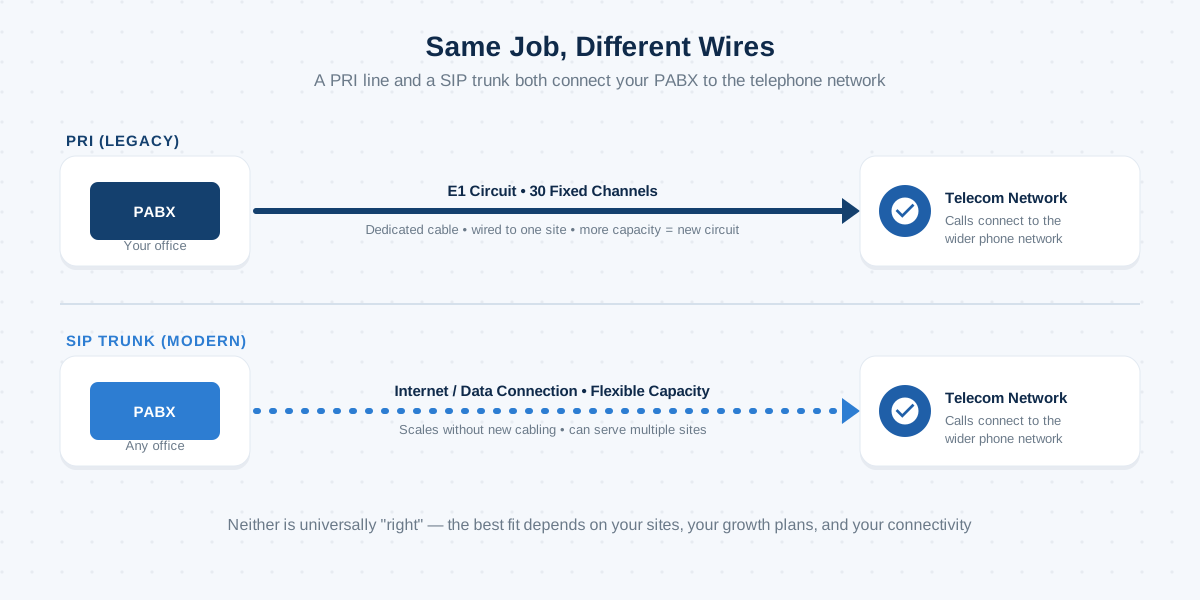
Before PRI, if a business wanted ten people to be able to make or receive calls at the same time, it needed ten separate analogue phone lines running into the building — ten cables, ten ports, ten monthly line rentals. PRI collapsed that into one connection. In most of the world, including Nigeria, a PRI runs on what's called an E1 circuit, which bundles 30 voice channels (plus signalling) into a single digital line. Your office effectively gets 30 simultaneous call paths through one cable, managed by your PABX and handed out to extensions as needed.
It's the same basic idea as a multi-lane expressway replacing 30 single-lane roads. Same destination, far less physical infrastructure, much easier to manage centrally.
Why it has lasted so long
PRI technology is, by telecom standards, old. Yet it remains widespread in Nigerian offices for reasons that are less about nostalgia and more about practical business sense.
The hardware is already paid for. Many organizations invested seriously in PABX systems years ago — the physical unit, the phone handsets, the internal cabling. That's a real capital outlay, and if the system still works, replacing it purely to chase a new technology is a hard sell to any finance department.
It doesn't depend on your internet connection. A PRI line is a dedicated digital circuit from the operator, separate from your office broadband. In a country where internet quality can vary by neighbourhood, by time of day, or by how many people are on the network at once, having voice calls run on their own dedicated path — untouched by a slow Wi-Fi router or a congested office LAN — has real appeal. Your calls don't degrade just because someone in the next office is downloading a large file.
Staff already know how to use it. The desk phones, the internal extension numbers, the receptionist's console — all of it is familiar. For a business focused on its core operations rather than its phone system, "if it isn't broken, don't fix it" is a legitimate strategy, not laziness.
Where PRI starts to show its age
That said, PRI isn't free of limitations, and it's worth understanding them honestly.
Capacity is fixed and physical. If your 30-channel PRI is full and you need a 31st simultaneous call, you can't simply add a channel with a configuration change — you need another physical circuit, arranged through your operator, with its own installation lead time. Scaling up is a project, not a setting.
It's also geographically rigid. A PRI line serves one physical location. A business with branches in Lagos, Abuja, and Port Harcourt running separate PRIs at each site has, in effect, three disconnected phone systems that don't naturally share call routing, a common directory, or centralized reporting — the kind of visibility that a growing, multi-branch business increasingly needs.
And it doesn't travel. A PRI-based extension belongs to a desk phone wired into that specific PABX. Remote work, mobile staff, and the flexibility that many Nigerian businesses have leaned on since the shift toward hybrid work simply aren't part of what PRI was designed to do.
The alternative: SIP trunking
The modern equivalent of a PRI is a SIP trunk — the same basic function (a bulk connection carrying many calls to your PABX) but delivered over an internet or private data connection using the SIP protocol rather than a dedicated E1 circuit. SIP trunks are typically far more flexible: capacity can often be adjusted without new cabling, a single trunk can serve locations in different cities, and it integrates naturally with modern unified communications features — mobile apps, call recording, contact centre queues, and so on.
The catch is that SIP trunking depends on the quality of the underlying data connection, which is exactly the tradeoff many PRI-loyal businesses have been reluctant to make, especially where connectivity has historically been inconsistent.
You don't have to choose blindly
Here's the practical reality: neither PRI nor SIP is universally "right." A business with a rock-solid PABX, stable staffing, and one location may genuinely be better served sticking with PRI for now. A business opening new branches, hiring remote staff, or wanting a contact centre may have outgrown it entirely. Many others sit somewhere in between — comfortable with PRI today but wanting a clear, low-risk path to SIP and full unified communications when the time is right, without being forced into a disruptive all-or-nothing switch.
That in-between space is exactly where a lot of Nigerian businesses live, and it's why it's worth working with a telecom partner who is genuinely comfortable supporting you at whichever stage you're at — whether that's maintaining and optimizing an existing PRI and point-to-point setup, planning a measured PRI-to-SIP migration, or building out modern cloud PBX and contact centre capability from scratch — rather than one that only speaks the language of the newest technology and has little patience for legacy infrastructure that is still doing its job.
This post is part of an ongoing weekly series on telecom technology and business growth from the Vezeti team.
💬 Questions & Comments
Loading comments…
Leave a comment