
If you've ever set up a business phone system that runs on the internet — a SIP trunk, a cloud PBX, a contact centre platform — you may have come across the term "SBC" in a proposal or an invoice and quietly wondered what it actually is. You're not alone. It's one of those pieces of telecom plumbing that does its job quietly in the background, and most business owners never think about it until something goes wrong: calls that won't connect, a strange spike in international call charges, or an IT person saying "we need to check the SBC" during an outage.
So let's demystify it. An SBC — a Session Border Controller — is one of the most important pieces of equipment in any modern voice network, and understanding roughly what it does will make you a much sharper buyer of telecom services, whether you're in Lagos, Abuja, Port Harcourt, or anywhere else.
The simplest way to think about it
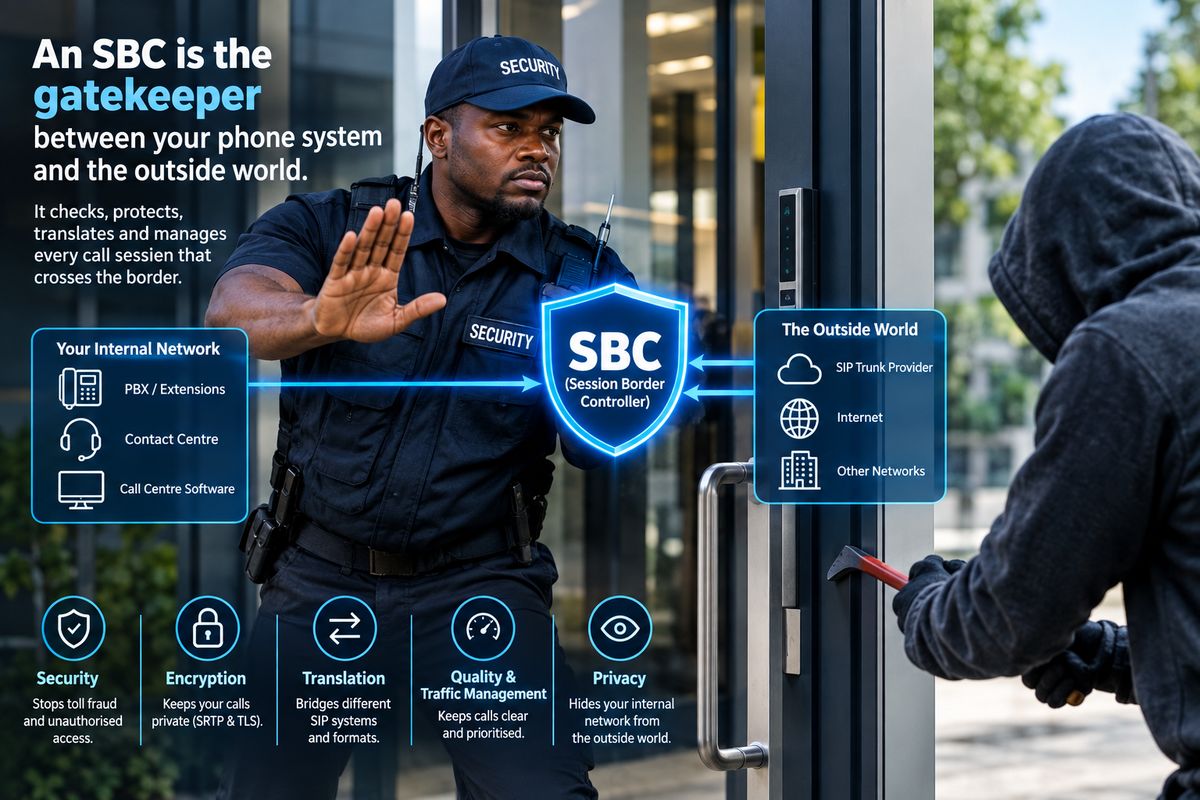
Picture your company's phone system as a house, and your voice calls as people walking in and out through the front door. An SBC is the security guard and gatekeeper standing at that door. It checks who's coming in, makes sure they're allowed in, watches for troublemakers, and manages the flow of traffic so the house doesn't get overwhelmed.
In more technical terms, an SBC sits at the "border" between your internal phone network (your PBX, your extensions, your call centre software) and the outside world — your SIP trunk provider, the wider internet, other companies' phone systems. Every call session that crosses that border passes through the SBC first.
That's really the core idea. Everything else it does flows from that one job: standing at the edge, watching every session that tries to cross.
What an SBC actually does for a business
Once you understand the gatekeeper idea, the specific jobs an SBC performs start to make sense:
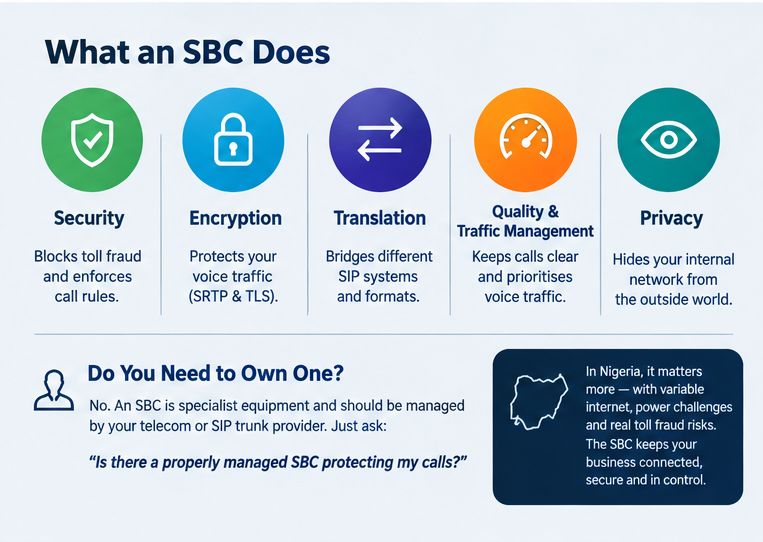
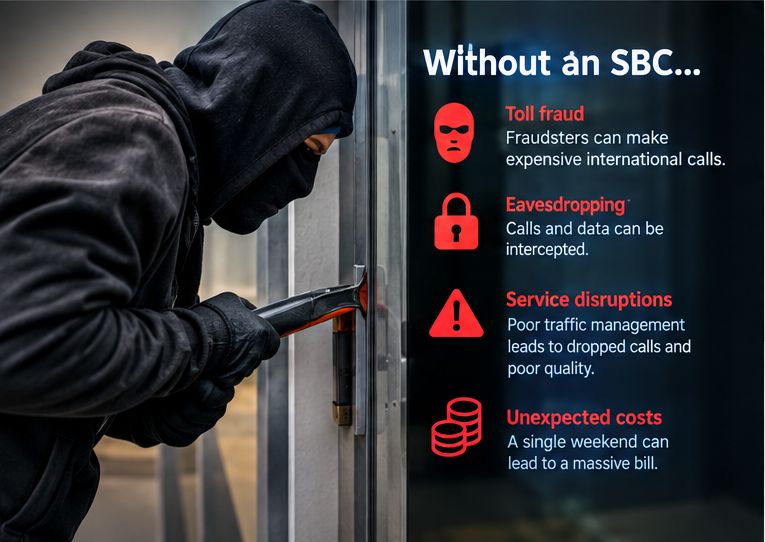
Security. This is arguably the biggest reason businesses need one. Just as a firewall protects your data network from hackers, an SBC protects your voice network from a very specific and costly threat: toll fraud. This is where criminals find a way into a poorly protected phone system and use it to make thousands of naira (or dollars) worth of international calls, often to premium-rate numbers, often overnight or over a weekend when nobody's watching. Businesses have been hit with shocking bills from a single weekend of undetected toll fraud. An SBC enforces who is allowed to place calls, from where, and how many at once, closing off the kind of gaps fraudsters look for.
Encryption. A properly configured SBC can wrap your voice traffic in encryption (often referred to as SRTP and TLS), so calls carrying sensitive business conversations — customer account details at a bank, a fintech's OTP verification calls, an internal strategy discussion — aren't sitting in plain, readable form as they travel across the internet.
Translation between different systems. Not every phone system "speaks" SIP in exactly the same dialect. An SBC can translate between slightly different signalling formats so that your PBX, your SIP trunk provider, and the person you're calling can all understand each other, even if their underlying equipment isn't identical.
Quality and traffic management. An SBC can prioritise voice traffic so calls stay clear even when your internet connection is also handling email, video calls, and general browsing — genuinely useful in Nigerian offices where bandwidth is often shared across many uses and connectivity isn't always perfectly stable. (For more on what makes calls sound choppy, see our guide to VoIP call quality, QoS and MOS scores.)
Keeping your internal network hidden. An SBC masks the internal details of your phone system from the outside world, so external parties see only what the SBC chooses to expose, not the raw structure of your internal network.
Why this matters more in a Nigerian context
A few local realities make the SBC's job especially valuable here. Many Nigerian businesses are mobile-first and internet access can vary in quality from one part of a state to another, which makes good traffic management and call prioritisation genuinely useful rather than a "nice to have." Power interruptions and the resulting reliance on backup connectivity (generators, inverters, alternate internet links) mean voice systems sometimes fail over between networks — an SBC that's properly configured helps calls survive that transition more gracefully.
There's also the fraud angle, which deserves special attention locally. Toll fraud isn't a hypothetical, foreign problem — it happens to Nigerian businesses too, often through phone systems that were set up quickly without proper security controls, or through default passwords that were never changed. A single unprotected extension, left open over a long weekend, can rack up an internationally-routed call bill that dwarfs a business's entire monthly phone budget. For a growing SME, that kind of unplanned naira exposure can be a genuine setback. This is exactly the kind of risk an SBC exists to close off.
Do you need to own one yourself?
Here's the good news: as a business owner, you almost never need to buy, configure, or maintain an SBC yourself. This is specialist equipment that requires ongoing tuning and monitoring — it's the kind of thing that belongs with your telecom or SIP trunking provider, not sitting in your server room as one more thing for your IT team to babysit.
What you should be doing, though, is asking the right question when you're evaluating a SIP trunk or cloud PBX provider: "Is there a properly managed SBC protecting my calls?" A serious provider will have a clear, confident answer. If a provider can't explain how they protect your voice traffic from fraud and eavesdropping, that's worth pausing on before you sign anything.
The bigger picture: meeting you where you are
This is really a story about how the pieces of modern voice infrastructure fit together to make your business more secure, not less. Whether a business is still running legacy analogue lines, has a PRI setup it inherited years ago, or is ready to move fully into SIP trunking and unified communications, the SBC is one of the quiet pieces of engineering that makes a safe transition possible — bridging old and new without leaving security gaps in between.
That's the kind of partner Vezeti aims to be: able to meet a business wherever it currently stands — from having no formal phone system at all, to running legacy analogue or PRI lines, to being ready for full SIP and unified communications — and help it modernise at a pace that makes sense, with the security fundamentals like SBCs handled properly along the way.
This post is part of an ongoing weekly series on telecom and business topics from Vezeti.
💬 Questions & Comments
Loading comments…
Leave a comment