
If you've ever made a call through Microsoft Teams, set up a virtual phone number for your business, or wondered how a call center agent can answer customer calls from anywhere in the world, you've already relied on a protocol called SIP — even if you've never heard the name.
SIP stands for Session Initiation Protocol. It's the technology that lets two devices — a desk phone, a laptop, a mobile app, a call center dashboard — find each other over the internet, agree on how to exchange voice (or video, or messages), and set up a live call. It's not the only piece of the puzzle, but it's the one that does the "hello, can we talk?" handshake at the start of almost every modern voice call that isn't traveling over the traditional copper phone network.
From copper wires to internet packets
For most of the twentieth century, phone calls traveled over a dedicated circuit — a physical, unbroken electrical path between two telephones, held open for the entire call. That system, the Public Switched Telephone Network (PSTN), is remarkably reliable, but it's also inflexible and expensive to scale. Every call needs its own reserved circuit, and moving or adding phone lines means physical wiring work.
SIP is part of the shift away from that model, toward voice traveling as data — the same kind of data packets that carry your email and web browsing. This is broadly called Voice over IP, or VoIP. Instead of reserving a physical circuit, your voice is broken into small packets, sent over the internet (or a private IP network), and reassembled on the other end. SIP is the protocol that sets up and tears down that connection: it's how your phone system says "I want to call this number," how the other end says "I'm ringing," and how both sides agree, "okay, we're connected, here's where to send the audio."
SIP doesn't carry your voice — it carries the instructions
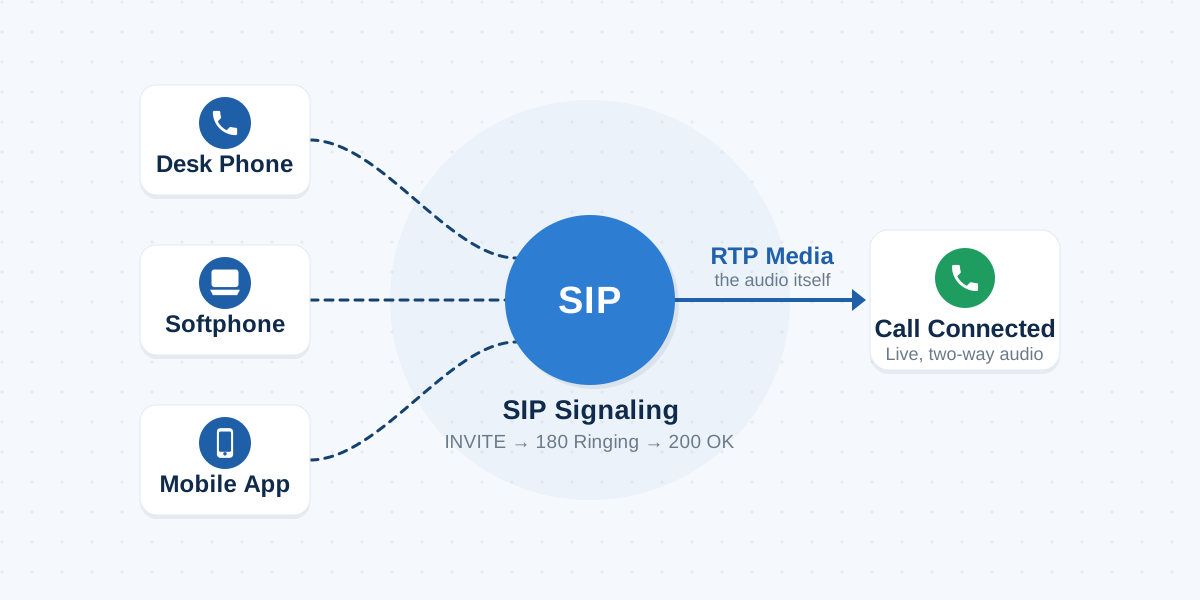
A common misconception is that SIP itself carries the sound of your voice. It doesn't. SIP is a signaling protocol — think of it as the part of a phone call that's like dialing, ringing, and picking up. The actual audio travels over a separate protocol, most commonly RTP (Real-time Transport Protocol), once SIP has done its job of negotiating the call.
This separation is part of what makes SIP so flexible. Because signaling and media are handled independently, a SIP-based system can support calls, video, instant messaging, and presence (the "online/away/busy" status you see in chat apps) all through the same basic framework.
Why this matters for a business
For businesses, the shift to SIP-based telephony has been one of the most practical upgrades in how they handle voice communication, for a few concrete reasons:
Flexibility of location. A SIP extension isn't tied to a physical desk or a wall socket. An employee can register the same extension from a desk phone in the office, a softphone on their laptop, and a mobile app — all reachable on the same number, wherever there's an internet connection. This is what makes fully remote and hybrid contact centers possible.
Cost efficiency, especially for international traffic. Because voice travels as data rather than through dedicated circuits, SIP trunking (the business equivalent of a bulk phone line, delivered over IP instead of copper) tends to be significantly cheaper than traditional PRI or analog lines, particularly for organizations making a high volume of calls or handling international traffic.
Easier scaling. Adding ten new agents to a contact center on a legacy PSTN system might mean physically provisioning new lines. On a SIP-based system, it's typically a matter of creating new accounts and assigning extensions — the underlying infrastructure scales without new copper in the wall.
Integration with the rest of the business. Because SIP-based calls are just another form of IP traffic, they integrate naturally with CRM systems, call recording and compliance tooling, analytics dashboards, and click-to-call features embedded directly into a website or mobile app.
Where it shows up without you noticing
SIP quietly underpins a huge amount of everyday communication infrastructure: cloud-hosted PBX (private branch exchange) systems for offices, contact center platforms, the "call this number" button inside many mobile apps, and the trunk connections that let a business's phone system talk to the wider telephone network at all. When a bank routes customer service calls to whichever available agent is logged in — regardless of which branch or country they're sitting in — there's a very good chance SIP is the mechanism making that routing possible.
The trade-offs worth knowing
SIP isn't magic, and it isn't automatically better in every dimension. Because it depends on the underlying network, call quality is only as good as the internet connection carrying it — which is why serious SIP deployments invest in Quality of Service (QoS) configuration, adequate bandwidth, and often a Session Border Controller (SBC) to manage security and traffic at the network edge. SIP traffic also needs to be secured properly (encrypted signaling and media, proper authentication) since, unlike a physical circuit, it's traveling across shared or public networks where it can in principle be intercepted or abused if left unprotected.
None of that changes the basic picture, though: SIP is the quiet, unglamorous protocol doing the handshake behind an enormous share of modern voice communication — from the call center routing your support call, to the softphone on a remote employee's laptop, to the click-to-call button on a company's website. Understanding what it does, even at a high level, makes it much easier to have an informed conversation about phone systems, whether you're evaluating a new business phone provider or just curious how the call you're on right now actually got connected.
This is the first in a weekly series on SIP, VoIP, and digital telephony topics. Future posts will go deeper into specific pieces of this picture — including SBCs, SIP trunking, codecs, and how call quality is measured and protected.
Questions & Comments
Loading comments…
Leave a comment