

Every growing business eventually has "the phone system conversation." Maybe you just opened a second branch in another part of Lagos, or you hired three remote staff in Abuja and Port Harcourt, or your office landlord mentioned the building's wiring needs an upgrade and someone asked, "while we're at it, should we even keep this phone box in the server room?"
That conversation usually comes down to one choice: do you keep your phone system on-premise, sitting in a cabinet in your office, or do you move it to the cloud? Both are legitimate choices. Neither is automatically "better." What matters is which one fits how your business actually operates today, and where it's headed next.
What a PBX actually does
A PBX (Private Branch Exchange) is simply the system that manages your business's internal calling — routing calls to the right extension, running your "Press 1 for Sales, Press 2 for Support" menu, handling voicemail, call transfers, and conferencing. Without it, every employee would need their own separate phone line to the outside world, which is expensive and chaotic to manage.
The question isn't whether you need this functionality — virtually every business with more than a handful of staff does. The question is where that system physically lives and who maintains it.
On-premise PBX: the system you own and house yourself
An on-premise PBX is physical equipment sitting inside your own office — usually a cabinet of hardware connected to your phone lines (whether that's old-style analogue lines, a PRI/E1 trunk, or a SIP trunk) and wired to handsets at each desk.
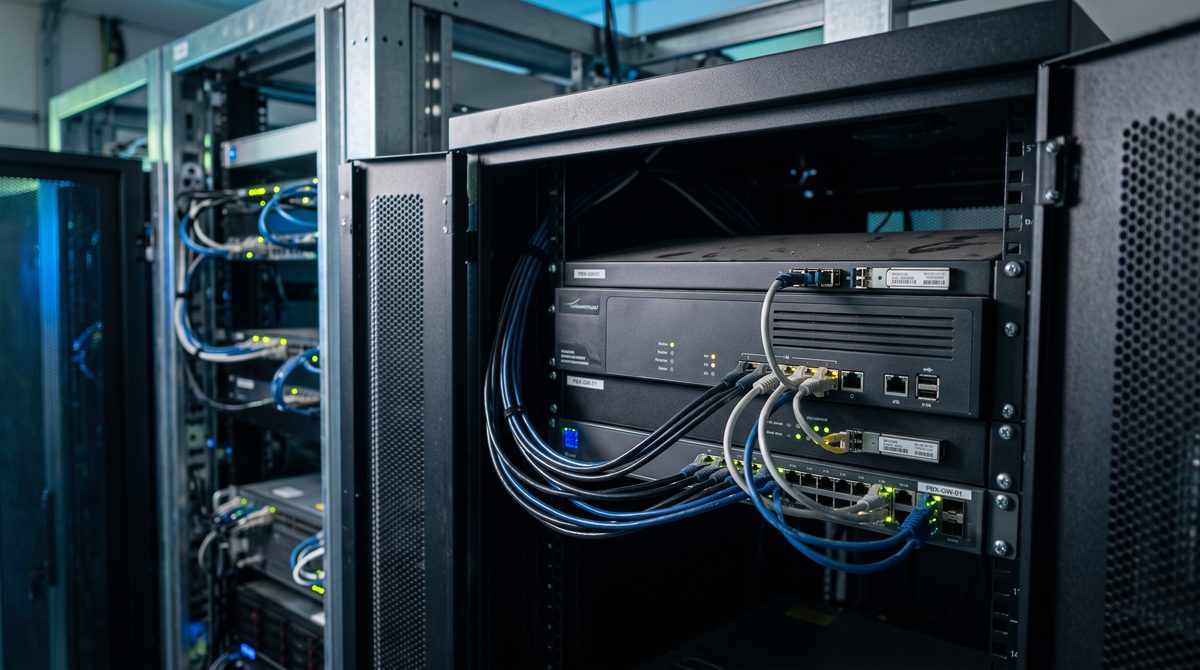
The appeal is straightforward: you own the box outright after you've paid for it, your call traffic never has to depend on an internet connection to function internally, and some business owners simply feel more comfortable having something they can point to and say "that's ours."
The trade-offs are just as real. You're paying a large amount upfront (capital expenditure) rather than spreading the cost over time. If a part fails, you need a technician to physically visit your office. Adding a new branch means buying and installing another box, not just a configuration change. And if you need to add ten new staff during a busy season, it's a hardware project, not a five-minute task. For a business with one fixed location and little expectation of expanding, that may be perfectly fine. For a business trying to grow quickly, it can quietly become a drag.
Cloud PBX: the system someone else hosts for you
A cloud PBX delivers the exact same functionality — extensions, call routing, voicemail, auto-attendants — but the actual system runs on a provider's servers rather than in your office. Your handsets, mobile phones, or desktop apps connect to it over the internet (this is where SIP, which we covered in an earlier post, does its quiet work in the background).
The appeal here is flexibility. Adding a new staff member or a new branch is usually a matter of creating a new extension on a dashboard, not buying new hardware. Your "office number" can ring on a desk phone, a mobile app, and a laptop simultaneously, which matters enormously for businesses with staff working from different locations. You pay a predictable recurring fee (operating expenditure) rather than a large lump sum, which is often easier to plan for in naira terms when costs are spread monthly rather than demanding one large outlay.

The honest trade-off: a cloud PBX depends on your internet connection. If your office's connectivity goes down, your calls can be affected — though this is increasingly managed through backup data connections, mobile failover, and the fact that cloud extensions can often still be reached on a mobile app even if the office itself loses power or internet.
The Nigerian context: why this decision carries extra weight here
In markets where power supply and internet connectivity are consistently rock-solid everywhere, this decision is almost purely about cost and convenience. In Nigeria, it's also about resilience planning.
Many Nigerian businesses already run on generators or inverters to manage power interruptions, and many already treat a second internet connection (often a mobile network data line) as a sensible backup rather than a luxury. A cloud PBX fits naturally into that mindset — because the intelligence lives off-site, a brief local power dip doesn't take down the whole phone system the way it might disable an on-premise box sitting on an unprotected circuit. At the same time, a business in an area with genuinely unreliable internet access, or one that strongly prefers to keep everything in-house for control and compliance reasons, may still have good reasons to prefer on-premise, or a hybrid of both.
There's also the multi-branch reality of doing business in Nigeria. A retailer with locations in Lagos, Ibadan, and Abuja doesn't want three separate, disconnected phone systems that can't transfer calls to each other. A cloud PBX naturally unifies branches under one system and one set of extensions, regardless of how far apart they physically are — something that's far more cumbersome to achieve with separate on-premise boxes at each site.
So which one should you choose?
A few honest questions tend to settle it:
Are you planning to add locations or staff in the next year or two, or does your headcount and footprint look stable for the foreseeable future? Faster growth tends to favor cloud. Do you have in-house IT staff who can and want to maintain physical equipment, or would you rather that burden sit with a provider? Is a large upfront cost something your cash flow can absorb right now, or would a predictable monthly fee suit your budgeting better? And finally — do any of your staff work remotely, from home, or across multiple branches, where a single unified number needs to follow them rather than sit fixed to one desk?
There's no universally "correct" answer, and it's worth being skeptical of anyone who tells you cloud is always right or on-premise is always wrong. The right system is the one that matches your actual operating reality.
You don't have to decide everything at once
This is a decision businesses are allowed to approach in stages rather than all-or-nothing. A business running an older analogue or PRI-based phone system today doesn't need to rip everything out overnight to benefit from more modern calling features — that system can often be bridged toward SIP and cloud capability gradually, at a pace the business can actually afford and absorb. Whether you're starting with nothing, running legacy infrastructure that still works fine for now, or ready to move fully into a cloud-based setup, the goal is simply to make sure your phone system is helping your business grow rather than quietly holding it back.
This post is part of an ongoing weekly series on telecom and business growth topics from Vezeti.
💬 Questions & Comments
Loading comments…
Leave a comment