
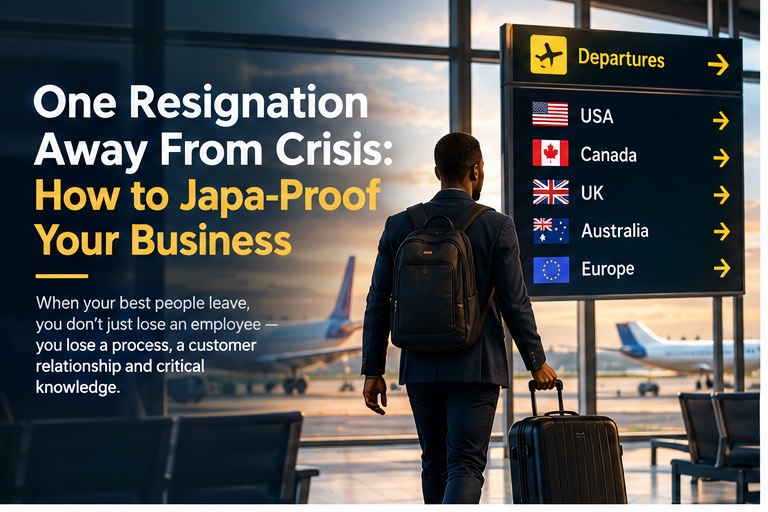
"Japa" started as a Yoruba word meaning "to escape" or "to flee." Today, in Nigerian pidgin, it means something far more specific: the wave of Nigerians — often the most qualified, most experienced, most difficult-to-replace ones — relocating legally or illegally to the US, Canada, the UK, Australia, and Europe in search of greener pastures.
For individuals, japa is a personal decision about opportunity and security. For business owners, it has quietly become one of the most serious operational risks in the country — a slow-motion talent drain that can hollow out a department, a team, or an entire business function almost overnight.
What the numbers actually show
This isn't a fringe anecdote — it's a documented, accelerating national trend. An Afrobarometer survey published in December 2024 found that 56% of Nigerians have considered migrating — up sharply from just 36% in 2017 — with 33% saying they had given it "a lot" of thought. Among Nigerians with post-secondary qualifications — exactly the skilled staff businesses depend on most — that number rises to 71%. The top reasons cited were finding better work opportunities (42%) and escaping economic hardship (39%).
The healthcare sector shows just how severe this can get in practice. Over the past five years, more than 57,000 Nigerian-trained nurses have left the country, with around 16,000 of them registering to practice in the UK over that same five-year period, according to the National Association of Nigeria Nurses and Midwives. On the doctors' side, Nigeria's Medical and Dental Council recorded over 3,000 doctors leaving the country in 2022 alone. The result, as reporting on the crisis has documented, is hospitals where a single nurse now attends to far more patients than recommended — a direct, measurable service-continuity failure caused by staff exodus.
Healthcare is simply the most visible example. The same underlying pressure — better pay, greater perceived security, and clearer career paths abroad — is pulling experienced staff out of banks, tech teams, engineering departments, and customer service operations across the country. For an employer, the pattern is familiar and painful: you invest in training someone, they become genuinely good at the job, and shortly after, they're gone — sometimes with almost no notice.

Why this is a business continuity problem, not just an HR problem
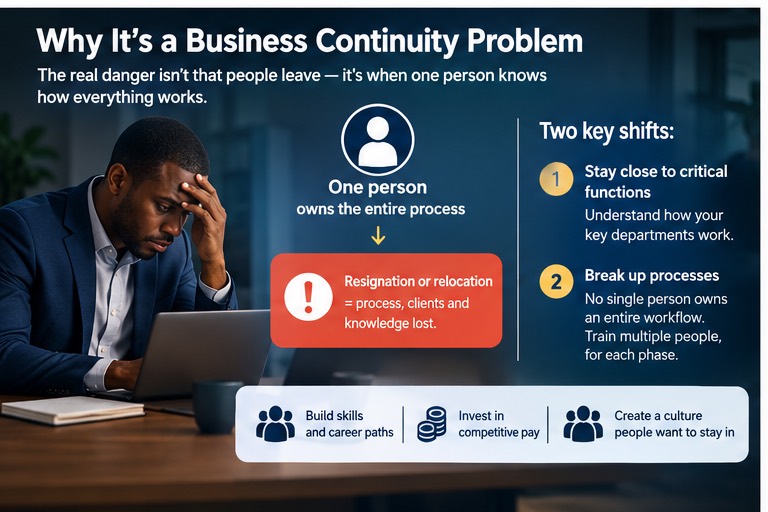
The real danger isn't that people leave — turnover is normal in any economy. The danger is when a business has quietly let one person become the only person who knows how something works. When that person resigns for a visa interview, or simply stops showing up because their relocation came through faster than expected, the business doesn't just lose an employee — it loses a process, a set of client relationships, and sometimes institutional knowledge that was never written down anywhere.
Two practical shifts make a real difference here.
First, owners and stakeholders need to stay close to the departments that can't be easily replaced or retrained. This doesn't mean micromanaging — it means genuinely understanding, at a working level, how the business's most critical functions operate, so that a single resignation letter can't leave leadership scrambling to even understand what was lost. A business owner who has never touched the process they're most dependent on is exposed in a way that's entirely avoidable.
Second, restructure critical operations so no single staff member owns an entire process end-to-end. Instead of one person handling a workflow from start to finish, break it into phases, and train different staff to competently handle each phase. Each individual piece becomes simple enough to learn quickly, which means a departure is a manageable handover rather than a crisis — and it becomes structurally very unlikely that everyone in a given chain resigns or relocates at the same time. This kind of compartmentalization is one of the most underused forms of business continuity planning in Nigerian SMEs specifically.
Can businesses pay their way out of japa?
Naturally, better pay helps — where a business genuinely can afford to move salaries closer to what the market or international offers demand, it will reduce some attrition. But it's worth being honest about the limits of that approach. Reporting on the japa trend consistently points to something more layered than compensation alone: professionals cite economic uncertainty, limited career growth, weaker social security systems, and a desire for a more predictable, secure future — not purely a bigger paycheck.
A Nigerian employee choosing between a modest raise at home and the perceived long-term stability of living abroad is often not making a purely financial calculation. This means retention strategy has to go beyond salary: real investment in skills development, clear promotion pathways, and a workplace culture people don't feel they need to escape all matter — alongside pay, not instead of it.
The overlooked risk: business communication tied to a personal phone
There's one japa-related risk that gets far less attention than it deserves: businesses that let staff run company communication through personal GSM lines and personal WhatsApp numbers.
Think about what that actually means in practice. A sales rep builds a relationship with a client over months, all through their personal mobile number. A support officer becomes the one customers instinctively call when something goes wrong — on a number that belongs to them, not the company. When that employee resigns to relocate abroad, or simply moves to a competitor, the business doesn't just lose staff — it can lose the customer relationship itself, because in the customer's mind, that phone number was the business.
This is precisely why every business — regardless of size — needs a clear policy: company business runs on company lines, not personal mobile numbers or personal WhatsApp accounts. A professional phone system means that when a customer calls, they reach the business, not an individual who may or may not still be with the company next month. It also means call histories, customer records, and communication threads stay with the business — not on a device that walks out the door with whoever resigns.
This is exactly the gap Vezeti's business phone solutions are built to close. With VezetiPBX, a small or growing business gets professional, branded phone lines — with call routing, IVR, and recording — so customer relationships belong to the company, not to any one employee's personal number. For larger organizations managing higher call volumes, VezetiCC brings the same principle to a full omnichannel contact center, with call recording and analytics that preserve institutional knowledge even as individual staff come and go.

Japa isn't going away as a trend, and no single policy will eliminate the risk it poses to Nigerian businesses. But the businesses that survive the wave of departures best won't be the ones that got lucky with who chose to stay — they'll be the ones that never let their continuity depend on any single person's phone in the first place.
This post is part of an ongoing weekly series on telecommunications, business growth, and digital transformation from Vezeti.
Sources
- Majority of Nigerians have considered emigration in search of opportunity — Afrobarometer (primary source, published Dec 2024)
- NANNM chairperson's comment on 16,000 nurses leaving Nigeria, misinterpreted — Dubawa (fact-check clarifying the correct 5-year framing of the nurse migration figures)
- The NMC Register, 1 April 2025 – 31 March 2026 — Nursing and Midwifery Council (UK, official registration data)
- From Training Tables to Departure Gates: The Data Behind Nigeria's Doctor Shortage — Dataphyte (citing MDCN data)
- The japa crisis and talent retention — TheCable
💬 Questions & Comments
Loading comments…
Leave a comment