
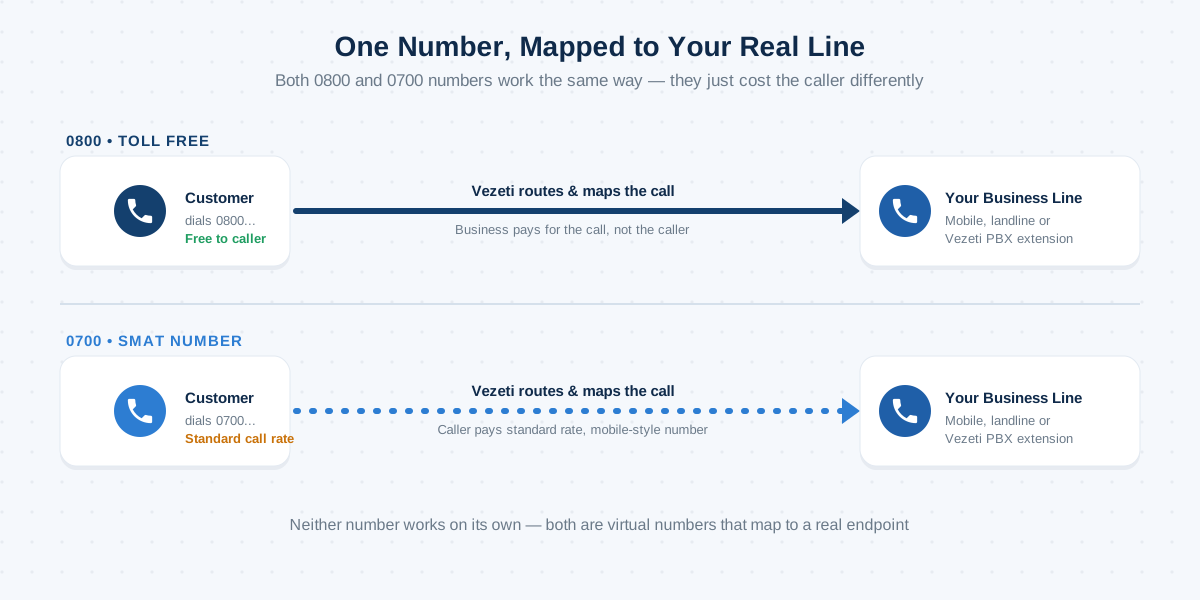
Many Nigerian businesses pick up a mobile-looking or memorable landline number as their primary business line — most commonly, an 0800 toll free number or an 0700 SMAT number. Both look and feel like a "real" phone number a customer can dial. Neither of them, however, works on its own. Understanding what's actually happening when a customer dials one makes it much easier to pick the right one for your business.
Neither number is a phone line by itself
An 0800 or 0700 number is a virtual number. It doesn't sit on a SIM card or plug into a wall socket anywhere. Instead, it's registered with a telecom provider and mapped to an endpoint — a mobile number, a landline, or, in Vezeti's case, an extension on your Cloud PBX. When a customer dials the number, the provider's network looks up where it's mapped to and rings that endpoint. To the customer, it feels like they've called your business directly. Behind the scenes, the call has been routed and handed off to wherever you've told the provider to send it.
This is exactly why either number can be reassigned, forwarded to a new line, or connected straight into a Cloud PBX for IVR and call routing — the number itself is just an address; the mapping is what makes it useful.
0800: The Toll Free Number
An 0800 number is Nigeria's toll free range. The defining feature is simple: the caller pays nothing to reach you — the cost of the call is billed to the business that owns the number instead. This is the classic customer-care and complaints-line number: it removes any hesitation a customer might have about the cost of calling you, which matters most when you want to encourage inbound contact — support lines, order lines, or a bank's or insurer's customer service desk.
The tradeoff is cost. Because the business absorbs the call charge, 0800 numbers typically carry a per-minute cost to the business, and are best suited to businesses where removing the caller's cost barrier is worth more than the per-call expense — high-value transactions, regulated services, or a brand that wants to visibly signal "we want to hear from you."
0700: The SMAT Number
An 0700 number is a mobile-style virtual number — it looks and dials like an ordinary Nigerian mobile number, but isn't tied to a physical SIM card on any one network. The caller pays the standard call rate to reach it, same as calling any other number.
Because it isn't locked to a single mobile network, an 0700 number gives a business a consistent, portable, professional-looking number — useful for a business that wants a single memorable number across branches, or that wants a number independent of any one telecom operator's SIM. It's a strong middle ground: more mobile and familiar-feeling to a Nigerian caller than a landline number, without the per-minute cost to the business that comes with 0800.
So which one should your business use?
There isn't a single right answer — it depends on what you're optimizing for:
Choose 0800 (Toll Free) if removing any cost barrier for the caller matters more than the per-minute charge to you — customer support, complaints, or care lines where you want every customer to feel free to call, no matter how long the conversation.
Choose 0700 (SMAT) if you want a professional, mobile-style number that isn't tied to a single carrier, without absorbing the caller's call cost — a general business line, sales line, or a single number to represent multiple branches.
Many businesses run both — an 0800 line for support, and an 0700 or landline number for general enquiries and sales — all mapped into the same Cloud PBX, so every call, regardless of which number the customer dialed, lands in one system with proper IVR routing, call recording and reporting.
This post is part of an ongoing weekly series on telecom technology and business growth from the Vezeti team.
💬 Questions & Comments
Loading comments…
Leave a comment