
You are on an important call with a client, a supplier, or your bank's contact centre. Halfway through, the voice starts breaking up. Words get chopped in half. Someone says "hello, are you still there?" three times in a row, and eventually you both give up and hang up to call back. If this has happened to you on a WhatsApp call, a Zoom meeting, or an office VoIP line, you have experienced a call quality problem — and there is real, measurable science behind why it happens and how it can be fixed.
For any business that depends on the phone to sound professional — and in Nigeria, where a phone call often closes the sale that a website only started — understanding what actually makes a call sound good (or bad) is worth a few minutes of your time.
What "call quality" actually means
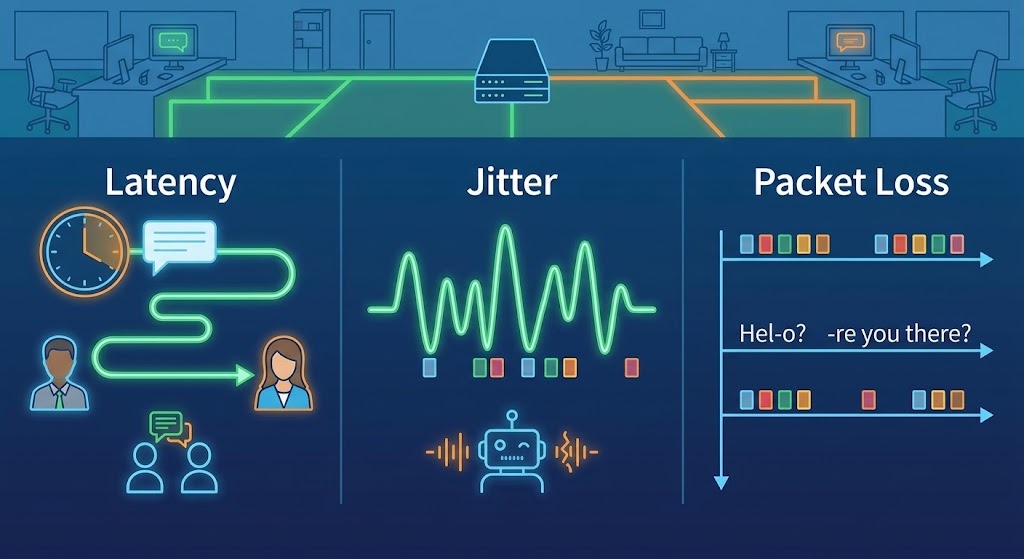
When people say a call "sounds bad," they are usually experiencing one or more of three underlying problems, all caused by how voice is broken into tiny data packets and sent across a network:
Latency is delay — the time it takes your voice to travel from your mouth to the other person's ear. A little delay is unavoidable and unnoticeable. Too much, and you get that awkward satellite-interview effect where both people start talking over each other because neither can tell when the other has finished.
Jitter is inconsistency in that delay. If some packets arrive quickly and others lag behind, the receiving system has to scramble to put your voice back together in the right order. The result is a choppy, robotic, or stuttering sound.
Packet loss is exactly what it sounds like — some of the tiny pieces of your voice never arrive at all. A little loss is masked by clever software. More than that, and you start losing whole syllables or words.
Any one of these, on its own, can turn a normal conversation into a frustrating one. In combination, they are the reason some VoIP calls sound worse than others, even on the same phone system.
Enter the MOS score
Engineers needed a simple way to describe "how good does this call actually sound," so the telecom industry adopted something called the Mean Opinion Score (MOS). It is a rating from 1 to 5, originally gathered by asking real listeners to score call quality, and now more often estimated algorithmically by monitoring the same factors described above.
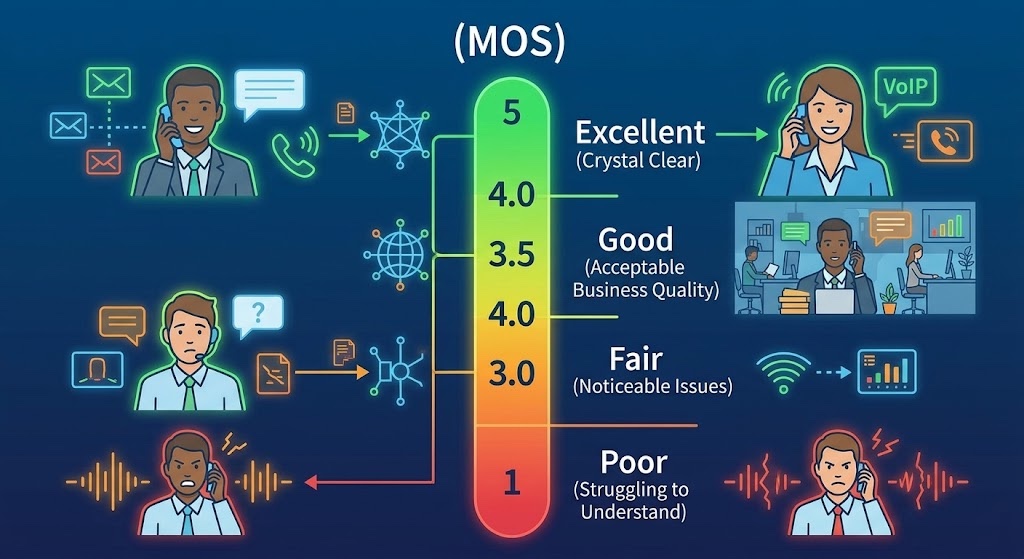
As a rough guide: a MOS above 4.0 sounds clear and natural, close to a traditional landline call. Around 3.5 is acceptable for most business use but noticeably less crisp. Below 3.0, callers start actively struggling to understand each other, asking people to repeat themselves, or preferring to switch to text.
If your VoIP provider or IT team can tell you your typical MOS score, that single number tells you far more about your phone system's real-world performance than "the calls just don't sound great sometimes."
Where QoS comes in
Quality of Service (QoS) is the set of network settings that gives voice traffic priority over other data. Think of it as a dedicated fast lane on a busy road. Without QoS, your voice packets are competing for bandwidth with everything else happening on your network at the same time — a colleague downloading a large file, a video call running in another room, a backup syncing to the cloud, or a dozen staff phones and laptops all pulling data over the same office WiFi.
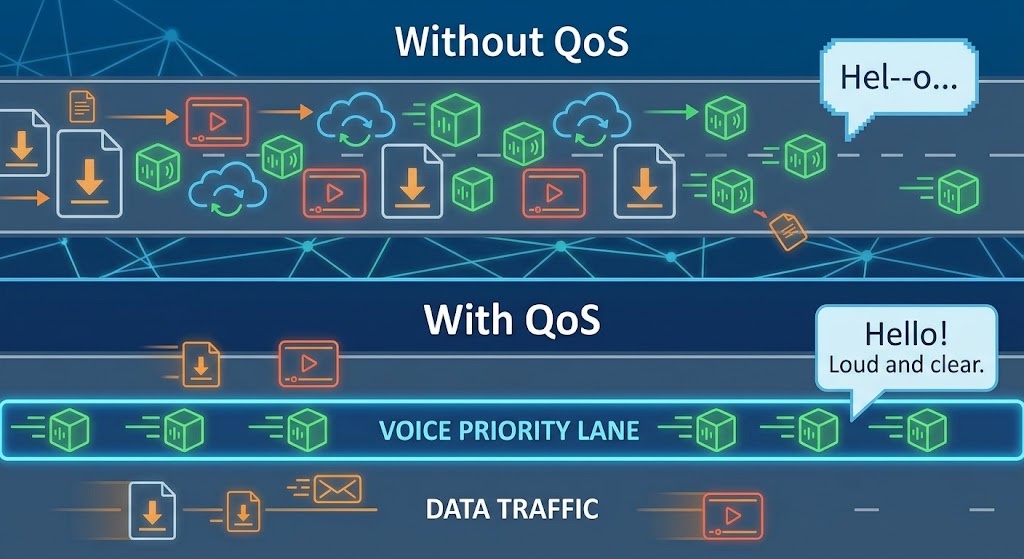
Voice is particularly sensitive to this competition because, unlike a file download, it cannot simply pause and resume — it needs a small, steady, uninterrupted stream of data in real time. Configuring QoS properly (on your router, switches, and internet connection) tells the network: "when in doubt, let the voice packets through first." It is one of the most cost-effective improvements a business can make to call quality, and often costs nothing beyond a competent setup.
Why this matters even more in the Nigerian context
Call quality challenges are universal, but a few local realities make them more visible here. Much of Nigeria's business internet access is mobile-first — 4G routers, MiFi devices, and mobile broadband rather than fixed fibre to every office — and mobile data networks can be more variable in latency and congestion than dedicated business circuits, especially during peak hours or in busy commercial districts. Power interruptions are another factor: when offices switch between mains power, inverters, and generators, networking equipment can momentarily drop and reconnect, which shows up as brief call glitches even when nobody touched a cable.
None of this means good VoIP call quality is impossible in Nigeria — far from it. Banks, fintechs, and contact centres run large-scale voice operations here every day. It does mean that the underlying network matters more than the phone or app on your desk, and it is worth choosing infrastructure and a provider that account for these realities rather than assuming a single ordinary internet line will always behave.
Practical steps to improve your call quality
A few habits and choices make a measurable difference. Where possible, connect key phones or PBX equipment by cable rather than WiFi — wireless adds an extra layer of variability. Ask whatever you use for internet — your ISP or router — whether QoS can be enabled to prioritise voice traffic, and if you have multiple internet connections, consider routing voice over the more stable one. If your business is growing past a handful of lines, ask your provider what redundancy exists — a secondary route or carrier that voice traffic can fail over to if one connection has a bad moment — rather than a single point of failure. And if quality complaints keep recurring, ask for MOS or call-quality reporting rather than relying on anecdotes; you cannot fix what you cannot measure.
The codec your system uses to compress voice for transmission also plays a role in the quality-versus-bandwidth trade-off — that is a big enough topic on its own that it deserves its own post another week.
The bigger picture
Whether a business is still running a single analogue line, has grown into PRI trunks, or has already moved to a full SIP-based setup, the same principles of network quality and prioritisation apply — the tools available to manage them just get more sophisticated as the infrastructure modernises. Part of moving to a well-engineered SIP or Unified Communications setup is that these quality safeguards — proper QoS, monitoring, redundant routing — become a built-in part of the system rather than something bolted on after the fact. Wherever a business currently sits on that spectrum, the goal is the same: calls that sound clear, connections that hold, and customers who never have to ask "sorry, can you say that again?"
This post is part of an ongoing weekly series on telecom and business growth topics for Nigerian businesses.
💬 Questions & Comments
Loading comments…
Leave a comment