
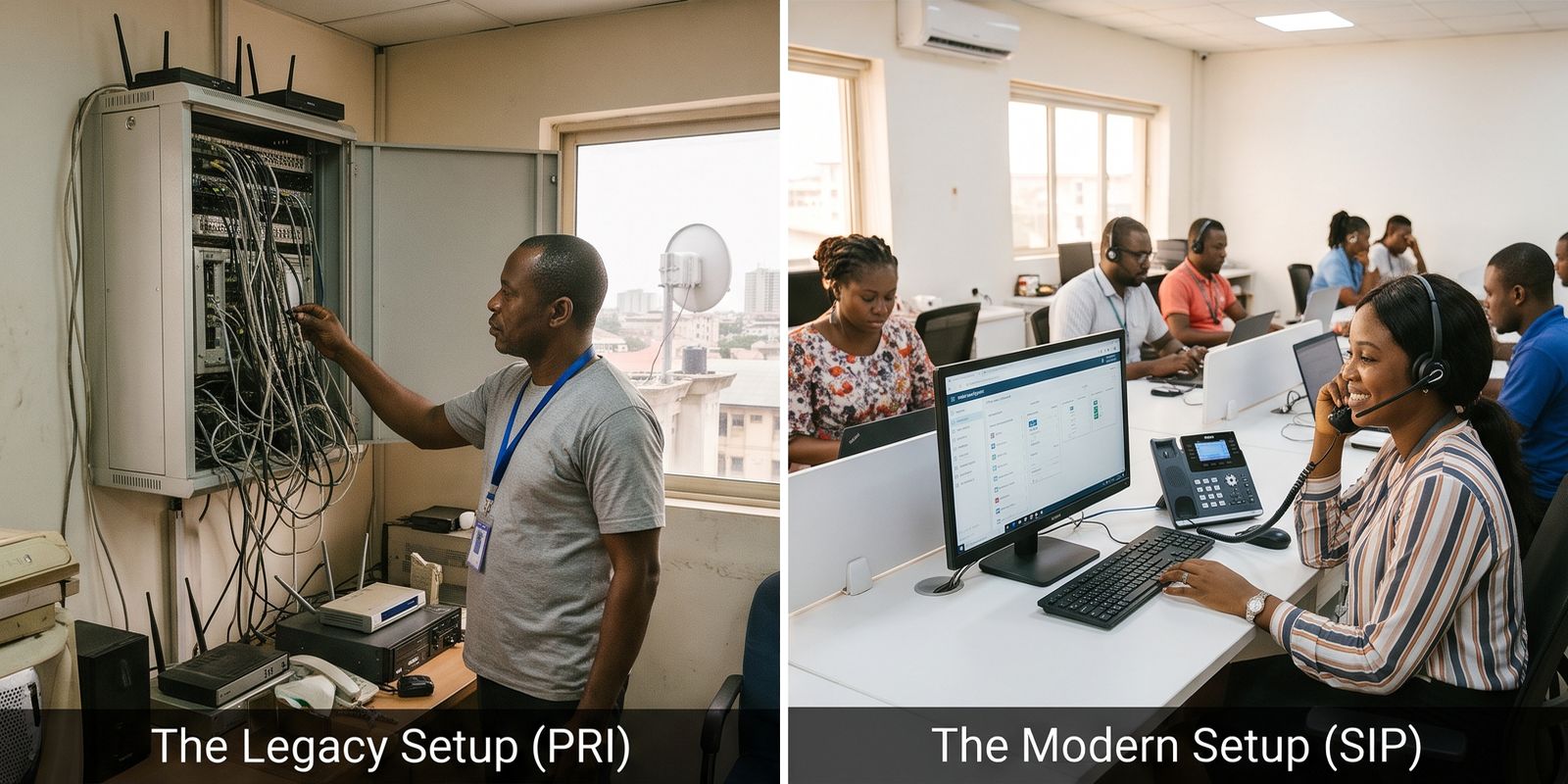
If your office still runs on a PRI line — whether that's a thick trunk cable feeding a phone cabinet in a back room, or a small microwave dish on the roof doing the same job over radio — you've probably heard the term "SIP migration" thrown around by every telecom vendor who's called you this year. What rarely gets explained is what that migration actually involves in practice: what changes, what stays the same, and what the switch-over day genuinely looks like for a business that still needs to answer its phones.
This matters more than it might seem. A phone system migration done badly means missed calls during business hours, confused staff, and a frustrating week of "can you hear me now?" For a Nigerian business where every missed call might be a missed order, that risk deserves a clear-eyed look before you commit to anything.
A quick refresher: PRI vs. SIP
A PRI (Primary Rate Interface) line is a fixed-capacity E1 circuit that your telecom provider delivers into your building and connects to an on-site phone cabinet (a PABX). In many other countries that circuit arrives over buried copper or fibre. In Nigeria, it's just as common — often more common, especially outside the core of major cities — for that same E1 to be delivered over a microwave radio link or another point-to-point radio connection, with a small dish or antenna on the roof standing in for buried cable. Given how much fibre in Nigeria gets cut by road construction or vandalised, many businesses and their providers have leaned on radio links precisely because they don't depend on digging up streets to lay cable, and a line-of-sight radio path can often be installed faster than a trench.
Whether it arrives by cable or by radio, the PRI line itself behaves the same way from the PABX's point of view: it carries a set number of simultaneous calls down a dedicated connection, and it has worked reliably for decades. The catch is that it's rigid either way: capacity is fixed by the circuit, moving offices means re-pointing a dish or re-running cable, and it can't easily stretch to cover a second branch or a team working from home.
SIP (Session Initiation Protocol) trunking replaces that physical circuit with calls carried as data over an internet connection. The phone cabinet either gets replaced by a cloud-based system or gets a gateway that lets it talk SIP instead of the old protocol. Capacity becomes a matter of configuration rather than cabling, multiple office locations can sit on one unified system, and staff can take the office line with them on a laptop or mobile app.
Neither one is simply "wrong" — a stable PRI line serving a single-location business well is not a problem that needs solving overnight. The migration conversation usually starts when a business is growing, opening a second location, needs staff to work remotely, or is simply tired of being limited by a fixed number of lines.
What a real migration actually looks like
Here is the part most sales conversations skip over. A properly handled PRI-to-SIP migration is a planned, staged project, not a single risky afternoon:
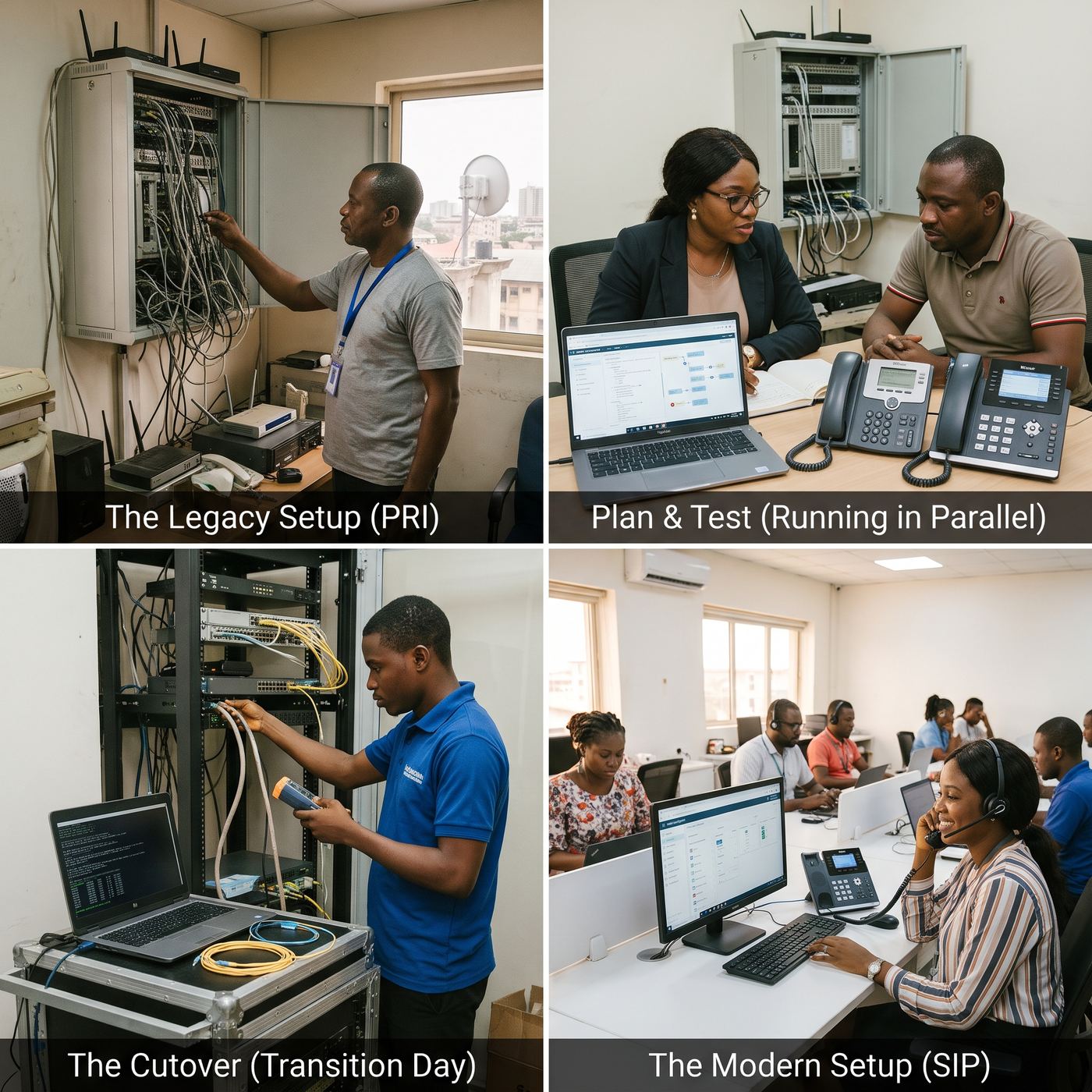
- Assessment first. A good provider starts by mapping exactly what you have today — how many lines, how calls are currently routed (a receptionist, an auto-attendant, specific extensions for specific departments), what hours you operate, and what absolutely cannot go wrong during the switch. Skipping this step is how businesses end up with a shiny new system that doesn't actually route calls the way their operations need.
- Parallel running, not a hard cutover. The PRI line is not simply switched off the moment SIP is switched on. For a period, both systems typically run side by side, with new call flows tested on the SIP side while the PRI line continues handling live traffic. This is the single biggest safeguard against a bad migration day — if something isn't configured correctly, you still have a working phone system while it gets fixed.
- Internet readiness check. Since SIP rides on your internet connection, your bandwidth and connection stability get assessed before cutover, not discovered to be inadequate afterward. In a Nigerian context, this is where power stability and connection reliability genuinely matter — and interestingly, a business already running its PRI over a microwave radio link often has a head start here, since that same radio connection (or a similar one) can frequently be adapted to carry the data link SIP needs, rather than requiring an entirely new type of connection to be brought in. Either way, a provider worth working with will talk to you honestly about redundancy options (a backup connection, or failover routing back to mobile numbers) rather than assuming your connection will simply behave. (For more on what affects call quality over the internet, see our earlier guide.)
- Staff familiarisation. Even when the underlying technology changes completely, the day-to-day experience for your front-desk staff or your sales team should change as little as possible — same extensions, same transfer process, same voicemail habits, just on new infrastructure. A migration that requires retraining your whole team from scratch on day one is usually a sign the project wasn't planned with the end users in mind.
- A genuine cutover window, agreed in advance. Once testing confirms the SIP side handles calls correctly, there's a scheduled, pre-agreed moment where the PRI line is finally retired — ideally scheduled for your quietest hours, not decided reactively.
Why businesses go through this at all
The honest answer is rarely "because PRI is broken." It's usually one of a few specific triggers: the business is opening a second branch and doesn't want two disconnected phone systems; staff increasingly need to work from home or from client sites and the PRI-bound PABX can't follow them; call volumes have grown past what the fixed line capacity can handle; or the business wants modern features — call recording, queueing, reporting, integration with a CRM — that an ageing PABX simply can't offer.
None of these are urgent emergencies most of the time. They're usually reasons to plan a migration deliberately, on a timeline that suits the business, rather than a fire to put out this week.
Meeting you wherever you're starting from
This is really the core of how we think about this at Vezeti. A business running a perfectly functional PRI line today isn't doing anything wrong, and there's no requirement to rip it out tomorrow. What matters is that when the time is right — a new branch, a remote team, outgrown capacity — the path from where you are to a modern SIP and Unified Communications setup should be a managed, tested project with your existing operations protected throughout, not a leap of faith. Whether you're calling us from a legacy PABX, a stack of personal mobile lines, or anything in between, the goal is the same: get you to where you need to be, at a pace that respects what's already working.
This post is part of an ongoing weekly series on telecom technology and business growth for Nigerian businesses.
💬 Questions & Comments
Loading comments…
Leave a comment