
Two businesses in the same city, using the same VoIP provider, the same internet connection speed, can have completely different experiences on a phone call. One sounds like the person on the other end is sitting across the table. The other sounds like they're talking through a tin can on a bad day — even though, on paper, nothing else about the setup is different.
Often, the difference comes down to one small, invisible decision made deep inside the system: which codec is doing the work.
If you've read our earlier piece on call quality, jitter, and MOS scores, you already know that voice calls today travel as data, broken into tiny packets that cross the internet and get reassembled at the other end. What we haven't talked about yet is how your voice gets turned into that data in the first place — and that's exactly what a codec does.
What is a codec, and why should a business owner care?
"Codec" is short for coder-decoder. It's the piece of software that takes the analogue sound of your voice, compresses it into a stream of digital data small enough to travel efficiently over a network, and then decompresses it back into sound on the other end — ideally fast enough, and faithfully enough, that the conversation feels natural.
Every VoIP call, every SIP trunk, every cloud PBX extension in the country is running on top of some codec. You don't usually see it, choose it, or think about it — your phone system and your provider typically negotiate it automatically when a call connects. But the codec chosen for that call quietly decides two things that matter a great deal to a business: how clear the call sounds, and how much data it consumes to deliver that sound.
That second point is not a minor technical footnote in Nigeria. With mobile-first internet access common for many small and growing businesses, and data costs a real line item rather than an afterthought, the codec sitting invisibly behind your phone calls has a direct relationship with your monthly bills.
The three you'll hear about most
There are dozens of codecs in use across telecom and VoIP systems worldwide, but three come up again and again in conversations about business phone systems.
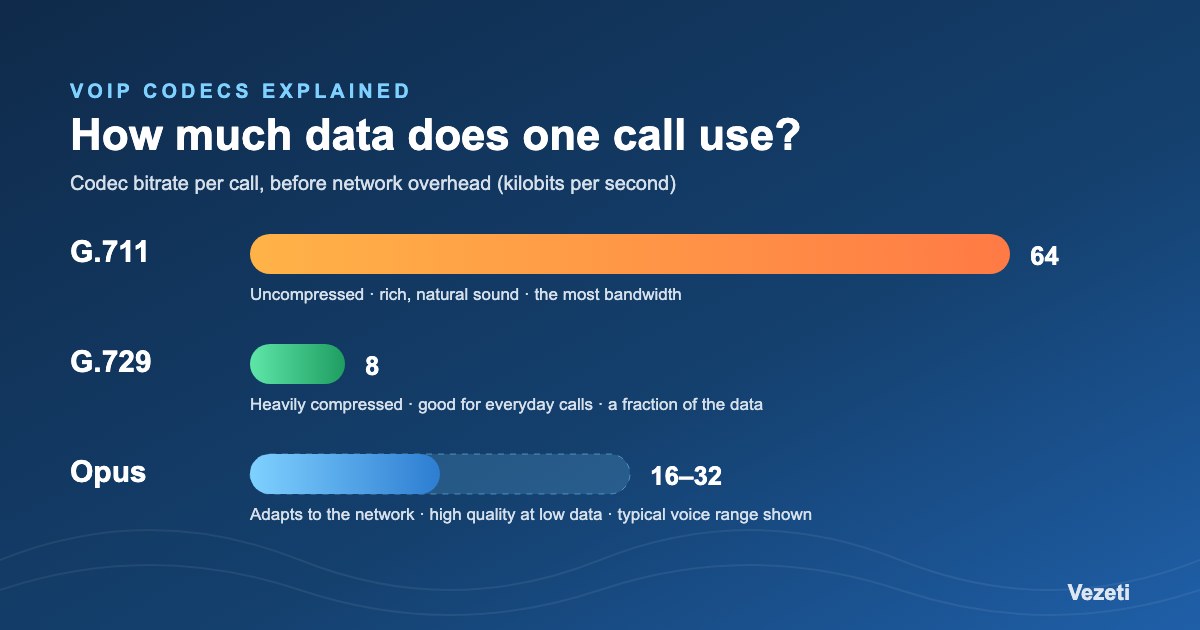
G.711 is the oldest of the group and the direct digital descendant of how traditional phone networks have encoded voice for decades. It prioritizes faithfulness to the original sound over efficiency, which means it delivers excellent, natural-sounding call quality — but it is "uncompressed" in practice, so it uses considerably more bandwidth per call than the alternatives below. It's still widely used, especially in legacy PBX environments and situations where internet bandwidth isn't the limiting factor.
G.729 takes the opposite approach. It compresses voice far more aggressively, using a fraction of the bandwidth that G.711 needs for the same call. The trade-off is a small amount of quality loss — most people find it acceptable for everyday business conversation, but it's noticeably less rich than G.711, particularly on calls with background noise or multiple people in the room. For businesses managing many simultaneous calls over a limited or costly internet connection, such as a contact centre running dozens of agents, that bandwidth saving can matter a great deal.
Opus is the newest of the three and, for many modern VoIP and WebRTC-based systems, has become the preferred default. It was designed specifically for the internet era: it adapts its bitrate dynamically depending on network conditions, can deliver quality that rivals or beats G.711 at a fraction of the bandwidth G.711 needs, and copes comparatively well with the kind of inconsistent connectivity that is still a day-to-day reality for many offices. Because it's open and royalty-free, it's also become a favourite among modern cloud communications platforms.
There are others worth knowing by name if you ever find yourself reading a technical spec sheet — G.722 (used for HD voice on some desk phones), AMR and EVS (common in mobile networks) — but G.711, G.729, and Opus cover the overwhelming majority of real-world business VoIP conversations.
Quality vs. bandwidth: the trade-off every business is making, whether they know it or not
Here's the practical tension underneath all of this: better-sounding calls generally cost more bandwidth, and more compressed calls generally cost a little bit of quality. There's no codec that gives you everything for nothing — every choice is a trade-off, and the right one depends on your situation, not on which codec is "best" in the abstract.
A small office with a handful of staff and a solid broadband connection might never notice a difference between codecs and can comfortably prioritize the richer sound of G.711. A business running a busy contact centre with many concurrent calls, or offices connecting over mobile data or a shared, metered connection, will often get far more practical value out of a bandwidth-efficient codec like G.729 or Opus — the savings in data usage, multiplied across every call, every day, every month, add up.
This is also why, if you've ever had a VoIP provider ask which codecs to "enable" or "prioritize" on your account, it wasn't a trick question — it was them trying to match the technology to how your business actually operates, rather than leaving it to chance.
It's a small setting with a real business impact
None of this requires a business owner to become a telecom engineer. The point isn't that you need to personally choose codecs — it's that a well-run communications provider should be making that choice thoughtfully on your behalf, based on how your team actually works, how many calls you run concurrently, and what your connectivity looks like day to day.
It's also a good reminder of something broader: the "phone system" a growing business runs on is rarely just one monolithic thing. It's a stack of smaller decisions — codecs, routing, failover, security — each invisible on its own, each capable of quietly making the difference between calls that build customer confidence and calls that chip away at it.
Whether a business is still running legacy PBX hardware tuned for older, uncompressed voice standards, already on SIP trunks optimized for bandwidth efficiency, or somewhere in between, the underlying goal is the same: calls that sound professional and connections that don't waste money doing it. That's as true for a business taking its very first step away from analogue lines as it is for one running a full cloud contact centre — the right configuration simply looks different at each stage, and a good partner should be able to meet you at whichever one you're currently on.
This post is part of an ongoing weekly series on telecom, VoIP, and business growth topics from Vezeti.
💬 Questions & Comments
Loading comments…
Leave a comment